
Marketing has evolved significantly over the past decade, and businesses are constantly looking for ways to work smarter, not harder. One of the biggest innovations driving this change is AI marketing automation. By combining artificial intelligence with automation tools, businesses can streamline repetitive tasks, deliver personalized customer experiences, and improve marketing performance without increasing workload.
Whether you’re a small business owner, marketer, blogger, or entrepreneur, implementing AI marketing automation can help you save time, generate better leads, and increase conversions. This guide will walk you through the process step by step, helping you understand how to successfully implement AI-driven marketing strategies in 2026.
What Is AI Marketing Automation?
AI marketing automation refers to the use of artificial intelligence technologies within marketing automation platforms to automate, optimize, and personalize marketing activities.
Unlike traditional marketing automation, AI can analyze customer behavior, learn from data, predict future actions, and make intelligent decisions in real time.
AI Marketing Automation vs Traditional Marketing Automation
Traditional Automation AI Marketing Automation
- Follows fixed rules Learns and adapts from data
- Basic audience segmentation Intelligent customer segmentation
- Generic email campaigns Personalized email campaigns
- Manual optimization Automated optimization
- Limited insights Predictive analytics and recommendations
Benefits of AI Marketing Automation
- Saves time by automating repetitive tasks
- Improves customer engagement
- Enhances lead generation and nurturing
- Increases conversion rates
- Delivers personalized experiences
- Provides actionable marketing insights
- Improves overall marketing efficiency
Why AI Marketing Automation Matters in 2026
Modern consumers expect personalized interactions across every digital channel. Companies who don’t live up to these standards frequently find it difficult to compete.
With AI marketing automation, businesses can:
- Understand customer behavior more effectively
- At the right time, send the right message.
- Improve marketing ROI
- Scale marketing efforts efficiently
- Build stronger customer relationships
As AI technology becomes more accessible, businesses of all sizes can leverage automation to stay competitive.
Step-by-Step Guide to Implementing AI Marketing Automation
Step 1: Define Your Marketing Goals
Before selecting any AI tool, identify what you want to achieve.
Ask yourself:
- Do you want more website traffic?
- Are you trying to generate more leads?
- Do you want to increase sales?
- Is customer retention a priority?
- Are you looking to improve email engagement?
Clear objectives will help you choose the right automation strategy and measure success effectively.
Step 2: Collect and Organize Customer Data
AI systems rely on high-quality data to make intelligent decisions.
Gather customer data from:
- Website analytics
- Email subscribers
- CRM systems
- Social media interactions
- Customer surveys
- Purchase history
Ensure your data is accurate, organized, and regularly updated. Poor data quality can significantly reduce the effectiveness of AI marketing automation.
Step 3: Choose the Right AI Marketing Automation Tool
Selecting the right platform is one of the most important decisions during implementation.
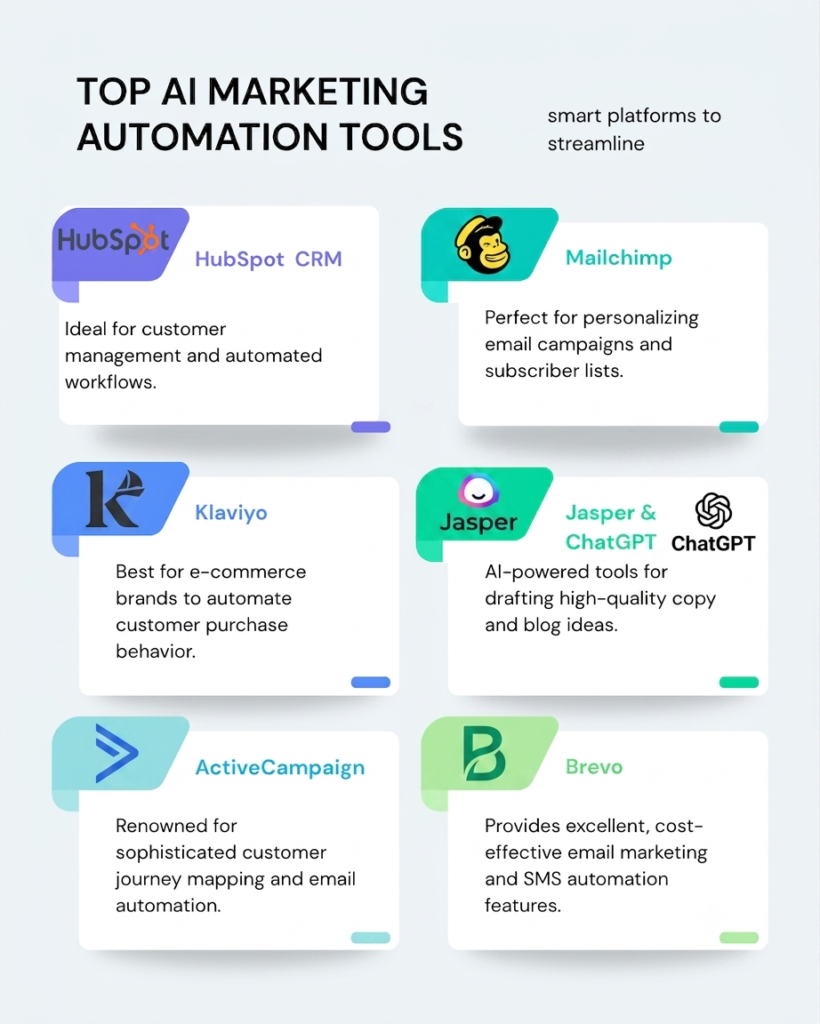
Free AI Marketing Automation Tools
- HubSpot Free CRM: Ideal for managing customer relationships and basic automation workflows.
- Mailchimp Free Plan: Great for email marketing automation and audience management.
- Brevo: Provides email marketing and SMS automation features.
- ChatGPT: Useful for content creation, email drafting, and marketing ideation.
- Canva AI: Helps create marketing visuals and social media content efficiently.
Paid AI Marketing Automation Tools
- HubSpot Marketing Hub: Comprehensive marketing automation solution for growing businesses.
- ActiveCampaign: renowned for its sophisticated customer journey mapping and email automation.
- Klaviyo: Popular among e-commerce businesses for personalized marketing.
- Jasper:AI-powered content generation platform for marketers.
- Salesforce Marketing Cloud: Enterprise-level solution with advanced AI capabilities.
For expert advice on growing your business online,visit alfiya.digital)” - How to Choose the Right AI Marketing Automation Tool for Your Business?
- Selecting the best platform depends heavily on your business model, budget, and technical expertise. Here is a quick breakdown to help you make the right choice:
- For E-commerce Brands: If you run an online store, Klaviyo or Omnisend are the top choices. They integrate deeply with platforms like Shopify and WooCommerce, allowing you to trigger automation based on exact purchase behavior.
- For B2B Companies: If your focus is on lead nurturing and long sales cycles, HubSpot or Salesforce will provide the advanced CRM capabilities and lead scoring infrastructure you need.
- For Content Creators & Bloggers: If you manage a newsletter or personal brand, Mailchimp or Brevo offer cost-effective, easy-to-use email marketing automation without unnecessary complexity.
Step 4: Segment Your Audience Using AI
Audience segmentation is one of the most valuable applications of AI.
AI can automatically group customers based on:
- Demographics
- Browsing behavior
- Purchase history
- Interests
- Engagement levels
This enables businesses to create highly targeted campaigns that resonate with specific audiences.
Step 5: Create Automated Customer Journeys
The route a person takes from learning about your company to becoming a client is known as the customer journey.
-
Example Customer Journey
Visitor downloads a free guide →Receives welcome email →Gets educational content →Receives product recommendations Makes a purchase →Receives follow-up communication
AI helps optimize every stage of this journey based on customer behavior.
Step 6: Automate Email Marketing Campaigns
Email marketing remains one of the most effective digital marketing channels.
With AI marketing automation, businesses can:
- Send personalized emails
- Optimize send times
- Create automated follow-up sequences
- Trigger emails based on user behavior
- Improve open and click-through rates
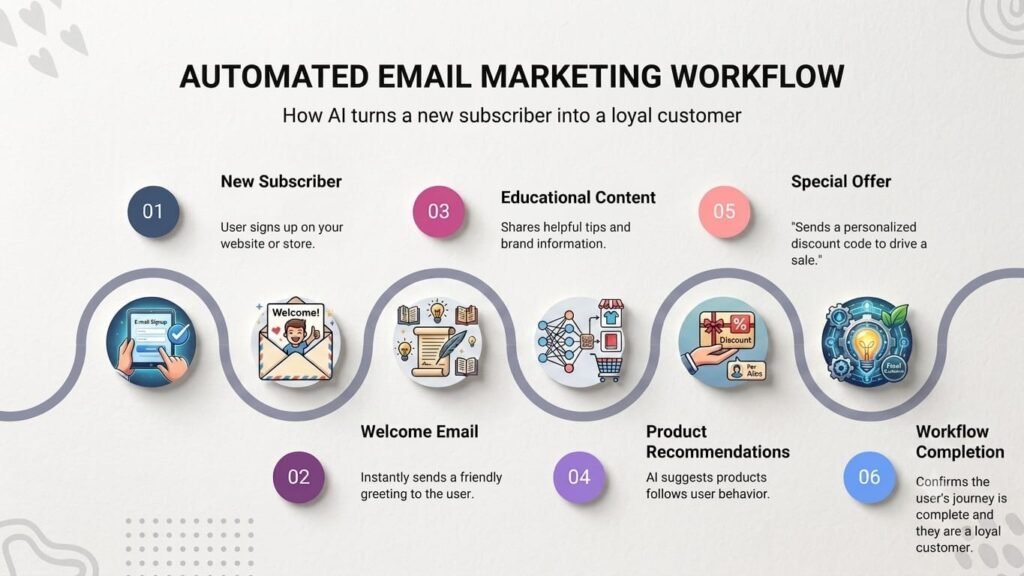
Example Automation Workflow
New subscriber →Welcome email →Educational email series →Product recommendation →Special offer →Conversion and customer loyalty tracking
Step 7: Implement AI-Powered Lead Scoring
Not all leads have the same purchase intent.
AI lead scoring analyzes factors such as:
- Website visits
- Email engagement
- Product page views
- Content downloads
- Form submissions
Based on this data, AI automatically identifies which leads are most likely to convert, allowing sales teams to prioritize their efforts.
Step 8: Monitor and Optimize Performance
Implementation is only the beginning. Continuous monitoring ensures long-term success.
Track important metrics such as:
- Website traffic
- Conversion rates
- Email open rates
- Click-through rates
- Lead quality
- Customer acquisition cost
- Return on investment (ROI)ts to optimize campaign performance.
Step 9: Train Your Marketing Team on AI Tools
Implementing the software is only half the battle; your team must know how to use it effectively. AI tools change rapidly, requiring continuous learning.
Invest in Certifications: Platforms like HubSpot Academy and Salesforce offer free certifications that can get your team up to speed.
Focus on Prompt Engineering: Since tools like ChatGPT and Jasper rely on human inputs, teaching your team how to write high-quality prompts will drastically improve content output.
Encourage Data Literacy: Ensure your marketers understand how to read AI-generated predictive analytics to make informed campaign pivots.
Real-World Example of AI Marketing Automation
Imagine a small online clothing store.
- Before Automation: Manual email campaigns, Generic promotions, Low customer engagement
- After AI Marketing Automation: Personalized product recommendations, Automated abandoned cart emails,Customer segmentation, Targeted promotions
As a result, the business experiences improved engagement, higher conversions, and increased revenue.
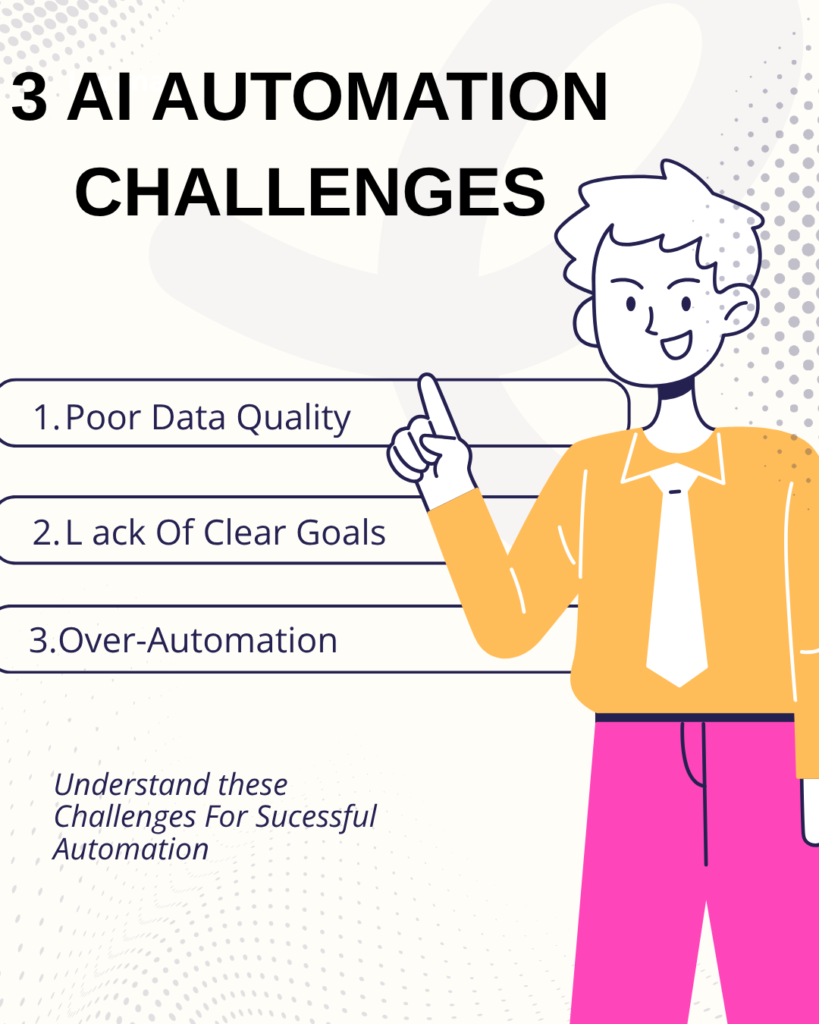
Common Challenges When Implementing AI Marketing Automation
- Poor Data Quality:Inaccurate data can lead to ineffective automation and poor customer experiences.
- Lack of Clear Goals:Without clear objectives, automation efforts may fail to deliver meaningful results.
- Over-Automation:Customer interactions may come seen as impersonal and robotic due to excessive automation.
- Choosing the Wrong Tool:Selecting a platform that doesn’t align with your business needs can create unnecessary complexity
Best Practices for Successful AI Marketing Automation
To maximize results:
- Start with a clear strategy
- Focus on customer experience
- Maintain clean and accurate data
- Test campaigns regularly
- Monitor performance metrics
- Combine AI insights with human Intelligence
Frequently Asked Questions (FAQ)
- Q1: Is AI marketing automation suitable for small businesses with limited budgets?
- Yes, absolutely! Many modern platforms, such as HubSpot CRM, Mailchimp, and Brevo, offer completely free tiers that allow small businesses to start automating their customer relationships and email marketing. You can scale to paid, premium features as your business grows.
- Q2: Will AI marketing automation completely replace human marketers?
- No. While AI handles repetitive tasks, analyzes huge datasets, and automates processes, it lacks the emotional intelligence, deep creativity, and strategic storytelling that human marketers possess. The most successful marketing campaigns are built when human creativity leverages AI efficiency.
- Q3: How long does it take to see tangible results after implementing AI?
- This depends on your goals, but many businesses notice immediate time-saving benefits within the first week of setting up workflows. You may often anticipate quantifiable, data-backed results for increases in revenue, email engagement, and conversion rates within 30 to 90 days.
- Q4: What is the ideal word count for an SEO article like this in 2026?
- Search engines favor in-depth, thorough, and high-value content that answers searcher intent comprehensively. While short blog posts can perform well, aiming for at least 1,500 to 2,500 words of comprehensive, well-structured information is highly recommended to achieve top rankings.
- Q5: How can I prevent my automated emails from sounding robotic?
- To maintain a human touch, avoid overly formal language and write as if you are speaking directly to one person. While using AI to customize the data fields (such as names, favorite subjects, or previous purchases), write the actual content in a useful, approachable, and conversational brand voice.
- Q6: What is the difference between Predictive AI and Generative AI in marketing?
- Generative AI (like ChatGPT or Jasper) focuses on creating content, such as drafting emails, writing blogs, or generating social media images. Predictive AI (found in Salesforce or HubSpot Hubs) analyzes historical data to forecast consumer behavior, such as predicting when a user is most likely to unsubscribe or buy a product.
- Q7: When employing AI marketing automation, is data privacy a concern?
Yes, data privacy is highly critical. Since AI relies on massive consumer datasets, businesses must strictly comply with regional data laws like GDPR, CCPA, and regional privacy frameworks. Always ensure that the AI automation tools you implement have clear data encryption policies and comply with user-consent management guidelines -
Conclusion: The Future of Marketing is Automated
- Implementing AI marketing automation in 2026 is no longer a luxury but a necessity for businesses aiming to scale efficiently. By streamlining repetitive workflows, leveraging predictive analytics, and delivering deeply personalized customer experiences, AI empowers marketers to focus on creativity and high-level strategy rather than administrative tasks.
- While the transition to AI-driven tools may present initial challenges, such as data management and tool selection, the long-term benefits in ROI and customer loyalty are unmatched. Start small by automating a single channel, like email marketing, and gradually scale your automation efforts as your data and confidence grow. The future of digital marketing belongs to those who combine human ingenuity with artificial intelligence.